South Park Heritage Trail
Raleigh, NC
Client: City of Raleigh
Year: 2023–2027
Type: Integrated Public Art / Cultural Placemaking
Status: Design Approved | Fabrication Begins Fall 2026 | Installation Expected 2027
ON THE BOARDS/ IN DEVELOPMENT 02
Overview
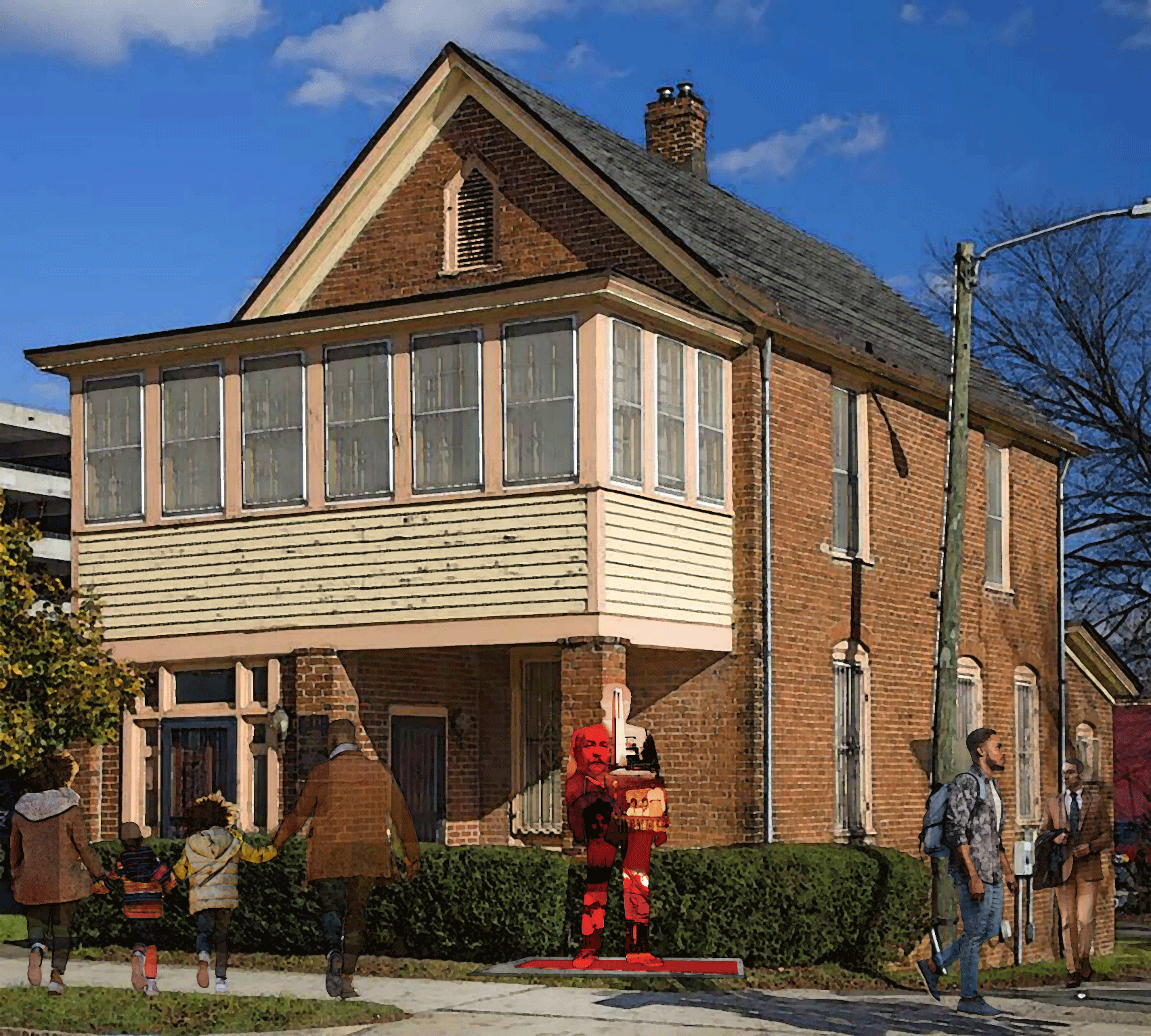
In 2024 I was selected to create public art for the South Park Heritage Trail, a cultural trail through Raleigh's largest historically Black neighborhood. The commission is a series of five sculptures in aluminum, each one an architectural silhouette set at a significant site along the route. Together they work as a set of markers, letting people stop at each site and see it, and also carrying one story along the length of the trail.
The sculptures are part of a larger trail system led by Design Workshop. It includes streetscape improvements, interpretive signage and wayfinding. I'm also working with the design team on the silhouette language used in the trail signage, so the artwork and the interpretive graphics read as one visual system.
Context
The East Raleigh-South Park Historic District grew up in the decades after the Civil War. It became the center of Black civic, commercial, educational and spiritual life in Raleigh: Shaw University, the businesses of East Hargett Street, the churches, the schools, and John Chavis Memorial Park. Urban renewal and redevelopment broke up much of that fabric, but the community held on to its stories.
The trail grew out of that memory. The South Park-East Raleigh Neighborhood Association (SPERNA) worked with the NC State University College of Design on a community-based report documenting the neighborhood's cultural history, and that report became the foundation for the trail. For me, the project connects to my own training at the College of Design and to my maternal family's roots in the Chavis community.
The Challenge
How do you mark history in places where much of the physical evidence is gone?
-
Several of the sites have changed a great deal or been lost, so the work has to bring back a presence that the buildings no longer give.
-
The sculptures sit in the public right of way. They have to be durable, hold up against vandalism, and be easy to maintain over the long term.
-
Five sites with five different stories still have to read as one body of work.
Each piece has to be a landmark at its own site and also part of a continuous story through the neighborhood.


Approach
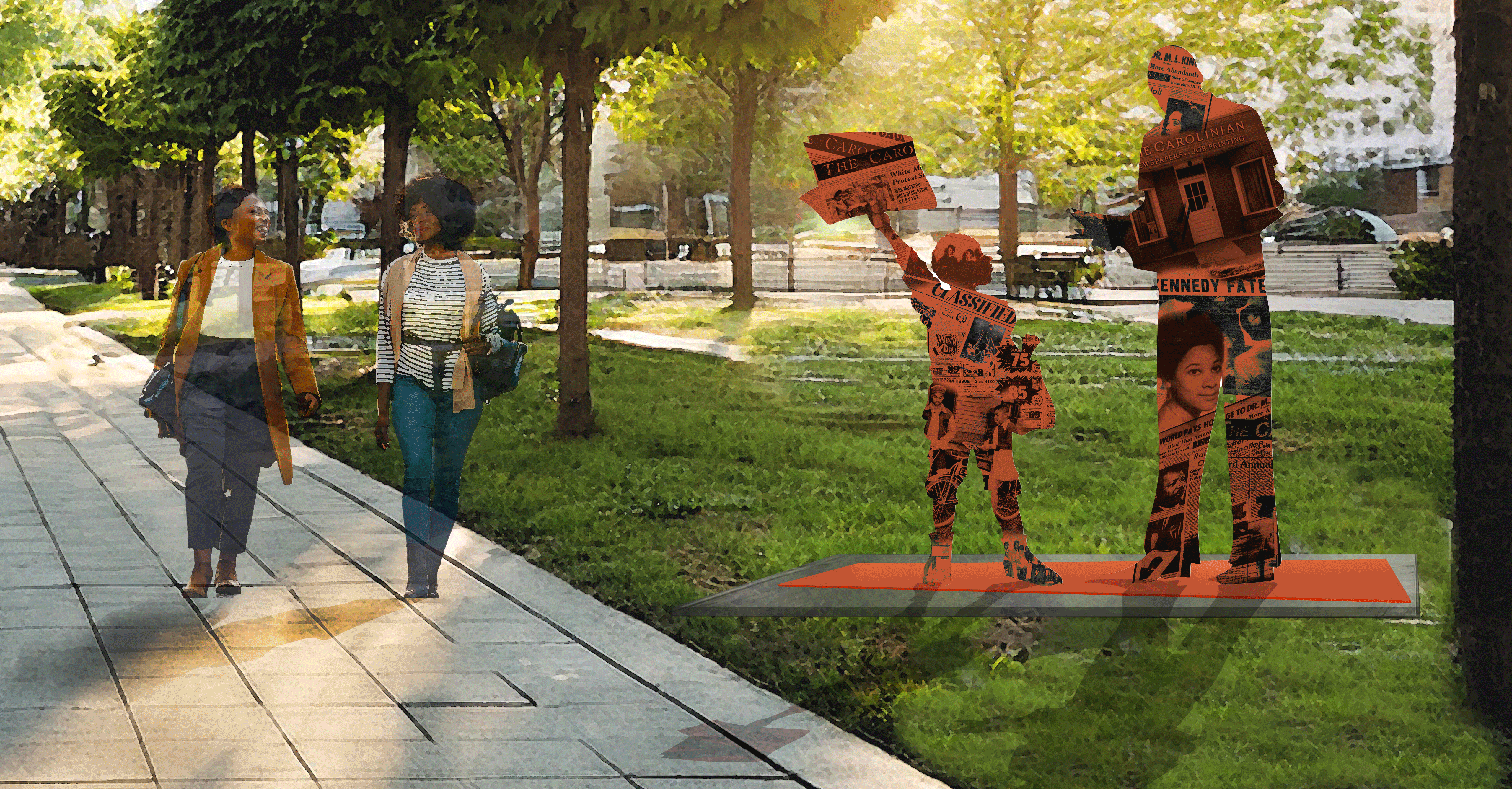
I began with archival photographs, community histories and the documentation in the SPERNA report, and then turned that material into a vocabulary of silhouettes: homes, institutions, and the people who filled them. The silhouette has long been a central motif in my work, standing for community, memory and heritage. Here it works at full scale. Each sculpture has two faces. The front carries a layered image tied to the history of its site, and the back uses reflective patterning or a vintage frame motif, so the piece changes as you move around it.
-
A unified structural and footing system across all five sites, so the series has one consistent language that can be built efficiently.
-
A shared silhouette library carried into the trail's signage, which ties the artwork into the wayfinding experience.
The Work
Black Main Street (Moore Square / East Hargett Street)
Two neighbors meet on Raleigh's historic Black Main Street. The front is a collage of the businesses that anchored it, including Hamlin Drug, the Lightner Arcade and the Delany Building. The back echoes Hamlin Drug's circular ring screen.
Sunday Read (The Carolinian / Chavis Way)
A newsboy and a reader stand at The Carolinian's original location. The front is a collage of headlines spanning eight decades, washed in the orange of the paper's banner. The back carries my house silhouette in reflective material, honoring the households who lived those stories.
Distinction (Pope House / Shaw University)
This piece honors Dr. Manassa Thomas Pope: Shaw-trained physician, civic leader, and builder of what is now the Pope House Museum. The back repeats the Shaw University bell tower.
Going to the Park (John Chavis Memorial Park)
Taken from a photograph of three boys watching the park train, these three figures stand for childhood, coming of age, and family at
Chavis Park. The backs carry empty vintage picture frames that invite viewers to bring their own memories.
Living Heritage (Washington High School / Mt. Hope Cemetery)
A family walks along Fayetteville Street. The collage brings together Washington High School, the neighborhood before and after Walnut Terrace, and Fayetteville Street Baptist Church. Nearby Mt. Hope Cemetery is where many of the people honored along the trail are buried.
Community + Cultural Engagement
The project builds on years of resident-led work and the City's public engagement sessions for the trail. The design has been approved by Raleigh's Public Art and Design Board.
Future Impact
-
Puts South Park's institutions, businesses and families back on the streets where they lived and worked, at full scale
-
Changes from day to night, so the work rewards repeat visits
-
Creates a visual language that can carry into future cultural trails in Raleigh
Project Team
-
Artist: J. Stacy Utley
-
Client: City of Raleigh, Parks, Recreation and Cultural Resources
-
Trail Design / Landscape Architecture: Design Workshop
-
Fabricator: ACSM
-
Structural Engineer: Morgan Structural
Image note: Archival photographs in the artwork come from DigitalNC (digitalnc.org) and from photographs community members shared during engagement sessions. Historic issues of The Carolinian are used with permission of the paper's editor.